If you’ve got an extra $164,000 laying around, and a sense of adventure, you might want to get your name on the waiting list for the Scubacraft. It’s essentially a speedboat with a specially designed trimaran hull that makes it just as comfortable on the water as it is under. And while technically you could refer to it as a submarine, it can only dive to depths of about 100 feet, and you’ll need to bring your own SCUBA gear since it doesn’t have an enclosed cabin. But thanks to a high-powered jet propulsion system you’ll be able to zip along under the waves or on top of them, depending on your mood, or escape plan. Orders for the Scubacraft are currently being taken, and delivery is expected somewhere near the end of 2010.
Looks like the recession hasn’t had much of an effect on California sea otters, one of whom was recently spotted in Monterey Bay with his own video camera.
“I was like, did I actually see an otter with a video camera or was I hallucinating?” [Aguirre] said.
The screen on Aguirre’s digital camera soon confirmed what he’d seen: an otter floating on its back, video camera grasped in its paws, lens aimed at the boat of excited photographers. The humans had a bad angle, but Aguirre managed to snap a single clear shot before the otter dived, video camera in tow.
“He’s the only one who got the photo,” Gideon said.
Judging by the rust and seaweed adorning the camera, the otter probably wasn’t getting much good footage. But Aguirre, who has photographed animals all over the world for more than a decade, said the otter aiming a camcorder was the “craziest” thing he’s seen an animal do in the wild.
The otter never resurfaced, leaving the photographers to speculate on the make and model of the animal’s gear. Aguirre suspects that the camera was dropped by a kayaking tourist and then picked up by the curious creature.
“I know I can go down there another million times and I will never see another otter with a video camera,” Aguirre said. “I think I have more chance of a penguin coming up to me and actually speaking English.”
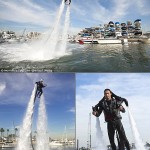
The big reason why it’s not the future and you don’t have a jetpack is fuel. Jetpacks are necessarily a compromise between the amount of fuel they can carry and the amount of weight they can lift, and so far the best you’ve been able to expect is 10 or 20 minutes of flying time. So if somehow you could get the fuel off of the jetpack, you’d be good to go… And that’s what the JetLev does.
The JetLev is a jetpack that’s powered by water. It doesn’t carry the water with it; rather, it’s got a 140 foot long flexible tube attached to a little boat that you drag along behind you. The boat has a 4 stroke 115 hp engine in it that pumps water up into the jetpack at 100 psi, and when that water comes shooting down out of the two nozzles at the sides, it puts out enough force to lift a person up to 50 feet in the air at speeds of 50 mph. Since you’ve got about 326 million trillion gallons of propellant at your disposal (and it recycles!), the only limit to the range and endurance of the JetLev is the gas in the motor boat pod thingy, which currently gives a range of nearly 200 miles.
There are downsides to being restricted to water, but upsides as well… Namely, if anything goes wrong, you’re no more than 50 feet away from a splash landing. The JetLev is reportedly a cinch to operate, and it costs about $128,000.
In humankind’s never ending quest to be just a little bit more badass than the previous generation, the Brits have taken it up a notch and are building the world’s fastest car, designed to be a good bit faster than a speeding bullet with a top speed of 1,050 mph. That works out to be about 1.4 times faster than the speed of sound. The Bloodhound SSC (super sonic car) consists of a seat and some wheels strapped to a V12 race engine strapped to a jet engine (pilfered from a Eurofighter Typhoon) strapped to a rocket, all integrated into a carbon fiber and titanium body.
”
This is not going to be the first car to break the sound barrier. That honor goes to ThrustSSC, a car powered by two jet engines and build by the same team who are now building Bloodhound SSC. Even if ThrustSSC is a bit of a granny car compared to what Bloodhound is supposed to be capable of, I think it still takes the prize for fastest looking. Pics and vid of it, after the jump. (more…)
The problem with the future is that by definition, it keeps on getting closer but it’s never quite here. Frustrating. It seems that although we haven’t reached the flying car stage yet, we’ve managed to make it to drivable airplane. The Terrafugia Transition is basically a little airplane with a pusher prop, four wheels, and foldable wings that is certified by both the FAA as a light airplane and by the NHTSA as a street legal (and safe and insurable) automobile. It’s certainly innovative, but in a lot of ways, it’s extremely simple: there’s no ducted fans or thruster pods or pulse jets to let you take off out of traffic jams or anything… It’s really just an airplane. With enough foldy bits to make it a car.
As far as mechanics go, the Transition is gas powered, with a range of about 450 miles. Anyone can get in and drive the car, although you need key code to deploy the wings, so your kids (or your cat) won’t be able to take off in the car, so to speak. You will need a pilot’s license to fly the Transition, but just a light sport license, which is significantly cheaper and easier to obtain. The first Terrafugia Transition is scheduled to take to the air next month, and you should be able to buy one for yourself by the end of 2009, for $194,000. For that price, you could buy a new car and a new plane… But try driving them both at the same time.
If a piece of clothing can’t be crammed into a washing machine come laundry day, then it doesn’t belong in my wardrobe. But if you happen to have a few ‘delicate’ items that require a hand washing lest they be destroyed in the washer, the Delicair Basin will do the hard work for you.
It’s basically a standard sized sink designed for the laundry room that features a set of 14 to 16 air jets powered by a 150 watt variable speed blower. The jets produce a gentle bubble action so instead of having to manually clean a piece of clothing you just toss it in the sink, add a little detergent and then set the timer for up to 30 minutes. With a price tag of about $300 the Delicair’s not cheap, but when you factor in the cost of those ‘delicate’ items it could actually be more affordable than having to replace them.
Yesterday, in Switzerland, Yves Rossy made the first official demonstration flight of his jet powered personal flying wing. He was dropped from a plane at 8000 feet and spent 5 minutes flying (horizontally!) over the mountains at speeds of up to 186 MPH before parachuting gently to the ground. The wing itself is 8 feet across, and is powered by four Jet-Cat P200 jet turbine engines outputting 50 pounds of thrust each with a flight time of up to 10 minutes. There’s no integrated control system besides a throttle; Yves controls the direction of the wing entirely with his body. The engines enable him to ascend (up to 1000 feet per minute) but don’t bet on being able to take off from the ground all by yourself. Not that you’ll be getting one of these anytime soon… So far, there’s only the one, and no plans to produce more, and even if there were, you can bet you wouldn’t be qualified to use one.
When a fire breaks out, any amount of time it takes for the fire department to arrive is too long. So in theory, a 2003 Ferrara pumper truck that’s been outfitted with a Mikoyan Gurevich (MiG) jet engine should dramatically cut response times right? As long as there’s an absolutely perfectly straight path between the firehouse and the actual fire that is.
But unfortunately this firetruck has had to make some sacrifices in the name of speed. The most problematic being the removal of its water tanks in order to accommodate the engine and the fuel tanks it requires. So while the pumper can deliver firemen in record time, it won’t be able to do much else except maybe start another fire as a result of its afterburner.
I’ll be honest: in the realm of sci-fi tech, I’d always thought of the personal jet pack as showing up after the flying car, neither of which would be making a realistic appearance anytime soon. Turns out I’m dead wrong: the personal jet pack that you can buy is set to be released December 11 of this year.
It may or may not surprise you to hear that jet packs (of a sort) are old news. Bell Aerosystems had a personal rocket belt back in the 1960s, and a few different companies are currently offering the same hydrogen peroxide powered sort of thing, including Tecaeromex, from whom you can buy a working version for $250,000. The downside of rocket belts is that they only get a maximum of 30 seconds flight time, and the fuel is expensive and dangerous. Bell Aerospace started working on an actual jet pack in the late 60s, which had a hypothetical flying time of 25 minutes and a top speed of about 80 mph, but dropped the project due to it’s complexity.
Luckily for us, Jetpack International (who has lots of experience with conventional hydrogen peroxide powered rocket packs) is working on a turbine powered jet pack with an estimated flight time of 19 minutes, with a range of 27 miles at a max altitude of 250 ft. Best news is that it runs on easily available and cheap jet fuel. The $200,000 price tag includes a training course, although it’s unclear what certification (if any) is required to operate a jet pack. Below is a video of one of Jetpack International’s conventional rocket belts, to give you an idea of how these things perform: